
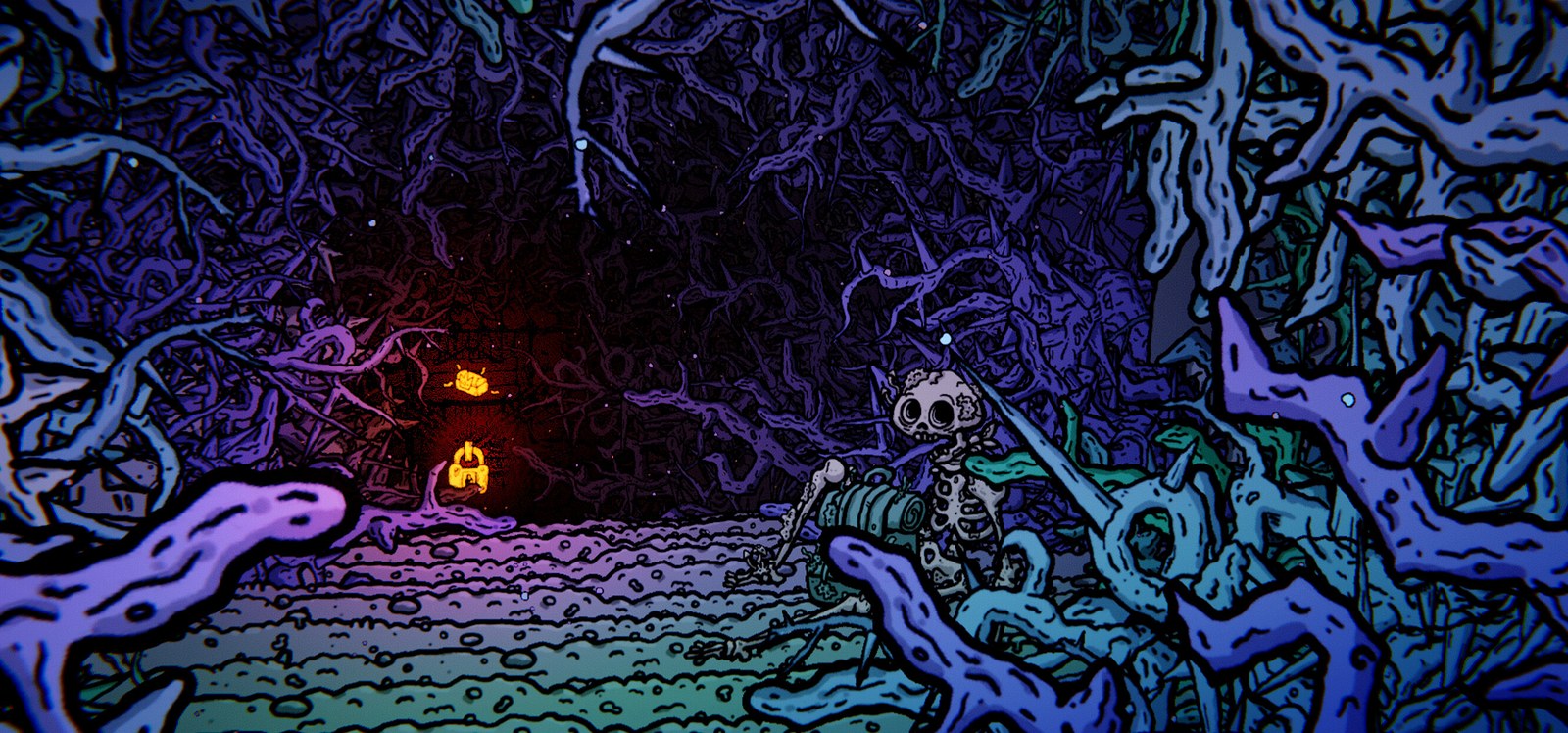
There is a moment in Shroom and Gloom where you realize you are not just playing a deckbuilder — you are playing two deckbuilders simultaneously, and they are both screaming for your attention. The combat deck in your left hand wants you to think tactically about damage output and survival. The explore deck in your right hand wants you to navigate branching dungeon corridors, unlock doors, and scavenge for resources. Fail at either one and your run ends. Master both and you start to feel like a fungal overlord.
Team Lazerbeam and Devolver Digital have dropped a first-person roguelike double-deckbuilder into Steam Early Access that feels like it was cooked up in a lab where Slay the Spire met Darkest Dungeon inside a haunted mushroom forest. It is early — the developers promise 12 to 24 months of additional content — but even in its current state, Shroom and Gloom is one of the most mechanically interesting roguelikes to land on the platform this year.
Game Overview
Shroom and Gloom is a first-person roguelike deckbuilder where you descend into hand-drawn underground dungeons overrun by monstrous fungi. The twist is the double-deck system: one deck governs turn-based combat encounters, while a separate explore deck handles dungeon navigation, card modification, and unlocking new weapons and abilities between fights. You pick from distinct character classes, each with their own card pools and pathways, and push deeper into procedurally generated runs where every decision compounds.
The game launched in Early Access on September 10, 2026, priced at $14.99 USD. It currently features two distinct pathways with unique characters, roughly 300 explore and combat cards per pathway, multiple quests, and a progression system built around growing and modifying your cards into increasingly absurd powerhouses. The developers at Team Lazerbeam — the studio behind Super Auto Pets — clearly understand roguelike design, and it shows in every hand you draw.
World, Story, and Central Premise
The premise is simple enough: you are a brave soul venturing into The Gloom, a subterranean world twisted by fungal corruption. The deeper you go, the stranger things get. What starts as mossy caves and damp tunnels eventually gives way to bioluminescent fungal cathedrals, fleshy organic corridors that pulse like living tissue, and environments that look like they were dreamed up by someone who ate the wrong mushrooms before bedtime.
There is not a deep narrative driving you forward in the traditional sense — this is a roguelike, and the story emerges from your runs. But the world-building is surprisingly rich for the genre. Each pathway has its own environmental theme, enemy roster, and visual identity. The hand-drawn art style gives everything a distinctive, almost storybook quality that sets it apart from the pixel-art crowd that dominates the roguelike space.
Gameplay and Combat
The moment-to-moment gameplay loop is where Shroom and Gloom truly shines. Combat follows the familiar roguelike deckbuilder template — draw cards, play cards, manage resources, survive — but the double-deck system adds a layer of strategic depth that keeps runs feeling fresh even after dozens of hours.
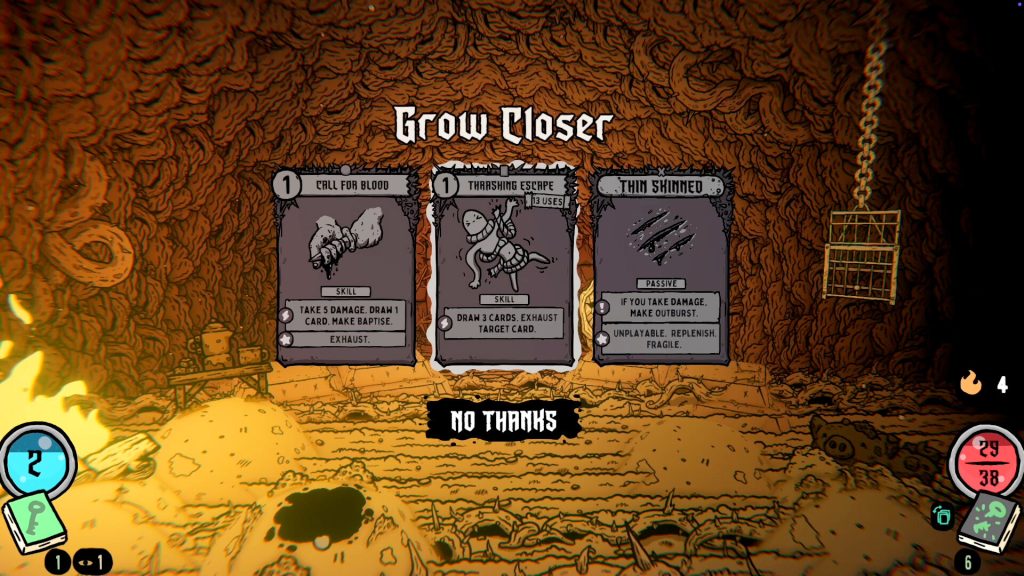
In combat, you play cards from your battle deck to attack enemies, defend yourself, and trigger synergies. The card pool is enormous and creative: you have standard attacks like Stab and Bash, but also more inventive options like Roast (which lets you cook enemies for later consumption) and Close Friend (which, despite the name, is very much an offensive tool). Cards can be grown and modified between encounters using your explore deck, turning basic starting cards into devastating endgame weapons.
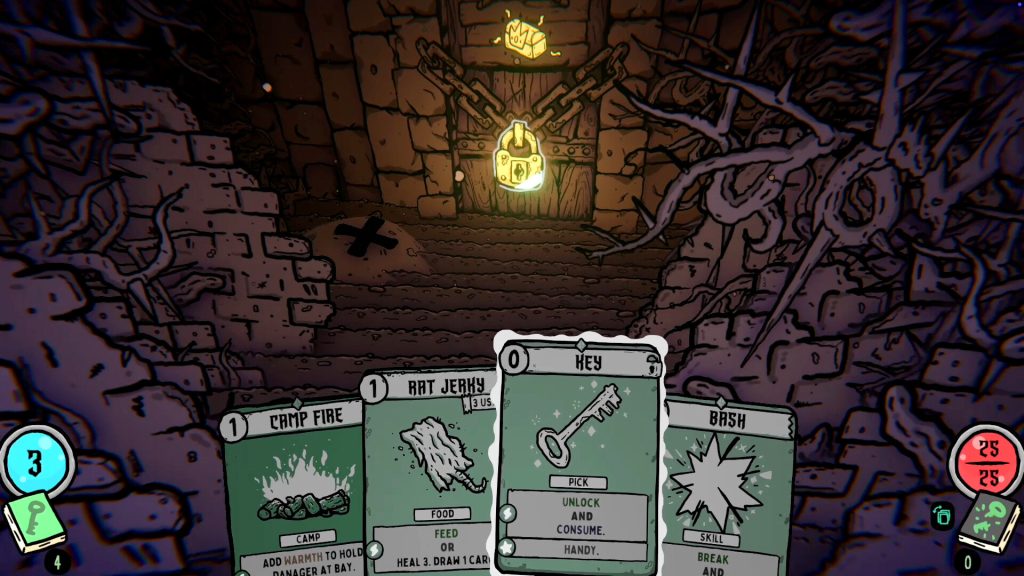
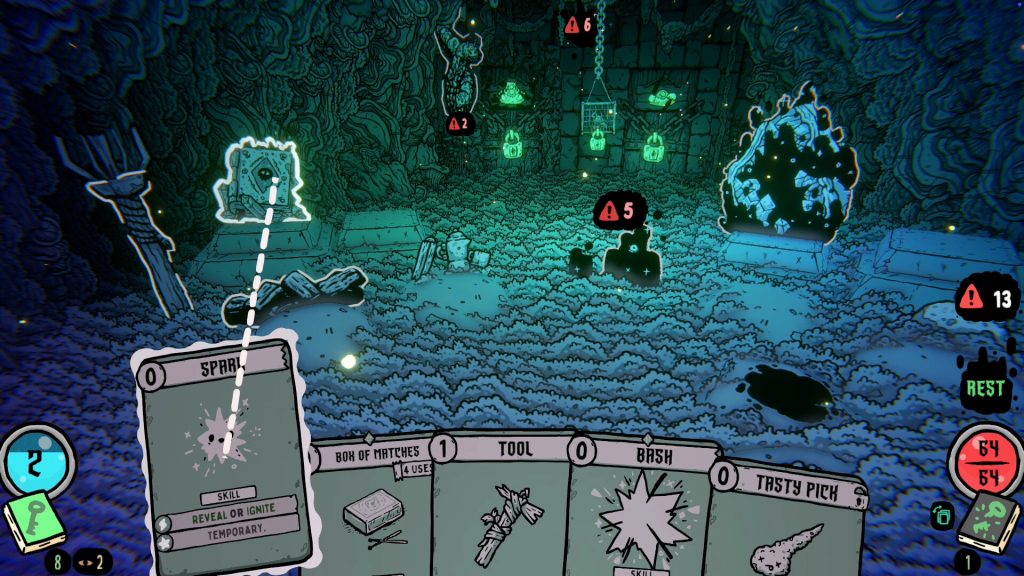
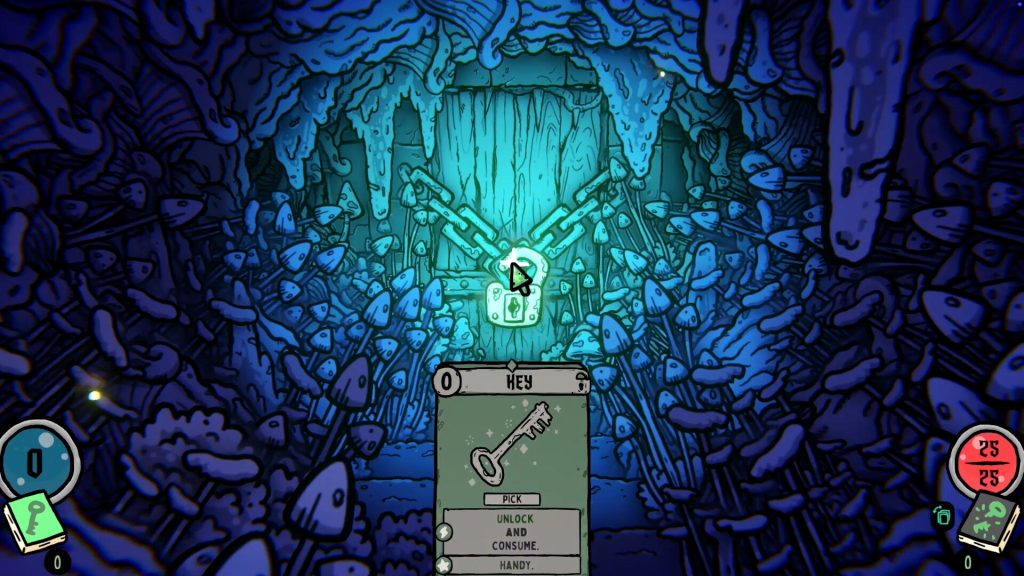
The explore deck is the game’s secret weapon. Between combat encounters, you navigate dungeon corridors using explore cards. Some open doors, others reveal hidden paths, and still others let you modify your combat cards or unlock entirely new abilities. This creates a fascinating tension: do you spend explore cards on finding treasure, or save them for critical doorways? Do you use your limited modification opportunities to buff your strongest card, or shore up a weakness?
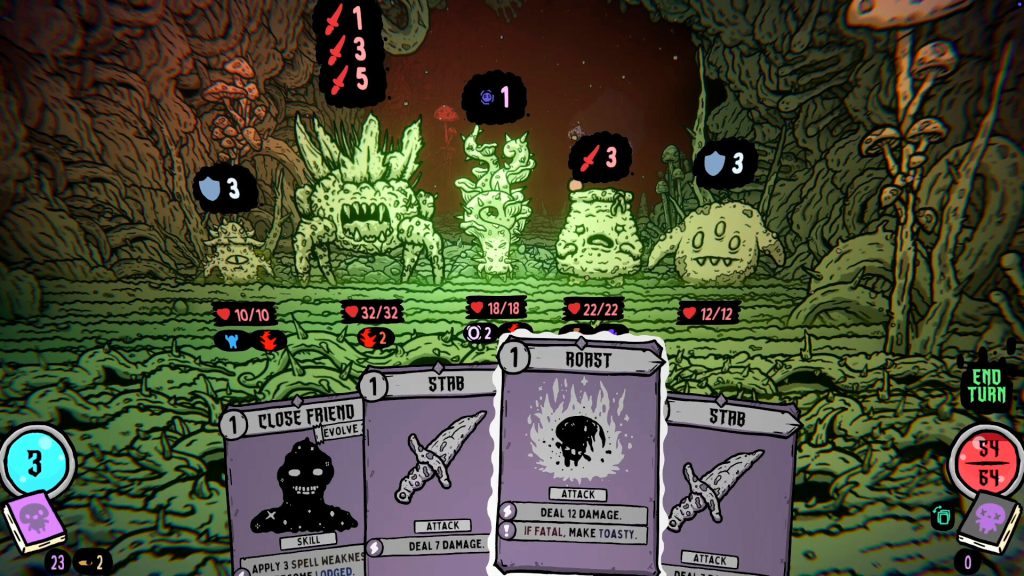
The eating mechanic deserves special mention. Instead of traditional blocking, Shroom and Gloom lets you season, skewer, and roast your enemies, then eat them to restore health. Cook up the right combination of roasted foes and you can brew soups that provide powerful temporary buffs. It is a brilliantly tactile system that makes every combat encounter feel like a culinary adventure as much as a tactical one.
Enemy variety in the Early Access build is solid, with distinct fungal creatures populating each pathway. The Janitor — a late-game foe that many negative reviews cite as a difficulty spike — is genuinely punishing, and the gunk mechanic it introduces can feel unfair on first encounter. But this is Early Access, and the developers have already shown responsiveness to community feedback.
Progression and Replayability
Roguelikes live and die by their replayability, and Shroom and Gloom delivers. The card growth system means that even familiar cards feel different from run to run. A basic Slash can be grown into a multi-hit devastation engine. A humble Camp Fire card can be modified into something that completely changes your defensive strategy. The possibilities compound in ways that keep the metagame interesting.
With two pathways, multiple character classes, and hundreds of cards to discover, the current content offering is generous for an Early Access title. The developers have outlined plans for new pathways with unique explore and combat cards, additional character classes, and more quests and challenges. If they deliver on that roadmap, the replay value could easily rival the genre’s best.
The unlock system provides additional motivation beyond pure run-to-run progression. New weapons, abilities, and card modifications unlock as you complete specific challenges, giving you reasons to try builds and strategies you might not otherwise attempt. It is a smart system that rewards experimentation without feeling grindy.
Visuals, Audio, and Atmosphere
This is where Shroom and Gloom distinguishes itself most clearly from its competitors. The hand-drawn art style is absolutely striking — bold outlines, saturated colors, and a visual language that feels like a dark fairy tale illustration come to life. Environments range from dark, oppressive tunnels to bioluminescent wonderlands, and the 3D spaces give the first-person perspective a sense of immersion that top-down deckbuilders simply cannot match.
The music complements the atmosphere perfectly, oscillating between eerie ambient soundscapes during exploration and more energetic tracks during combat. Sound effects are satisfying — the crunch of a well-timed attack, the sizzle of roasting an enemy, the satisfying click of cards slotting into place. The audio design reinforces the game’s unique identity at every turn.
The art direction extends to the cards themselves, which feature distinctive illustrations that make each one feel like a collectible piece of art. Even placeholder cards have character, and the upgraded versions often feature more elaborate artwork that visually communicates their increased power.
Performance and Technical Problems
As an Early Access title, Shroom and Gloom has its rough edges. Several negative reviews cite resolution settings resetting between sessions — a common Early Access annoyance that the developers should prioritize fixing. Some players report occasional crashes, though these appear to be relatively rare based on the review data.
The Chinese localization has been flagged by multiple reviewers as incomplete, with roughly a third of card descriptions not displaying correctly. For a game launching with Simplified Chinese support, this is a notable oversight. Steam Deck compatibility is also not yet confirmed, though the developers have acknowledged community requests for it.
The Janitor enemy and its gunk mechanic remain the most common gameplay complaint. Multiple reviewers with significant playtime (300+ hours) describe the mechanic as frustrating and poorly balanced, suggesting it needs tuning in future updates. Performance otherwise appears solid on recommended hardware, with the game targeting 60 FPS at 1080p on a GTX 1080 or equivalent.
Pros and Cons
Pros:
- Double-deck system adds genuine strategic depth to the deckbuilder formula
- Striking hand-drawn art style that stands out in a crowded genre
- Card growth and modification system creates deep replayability
- The eating and cooking mechanics are creatively brilliant
- Generous content for an Early Access launch with clear post-launch plans
- Atmospheric audio design that reinforces the fungal horror aesthetic
- At $14.99 USD, excellent value for the amount of content available
Cons:
- Resolution settings reset between sessions
- Chinese localization is incomplete with missing card translations
- The Janitor enemy and gunk mechanic feel overtuned
- No Steam Deck compatibility yet
- Some balance issues with explore deck economy in later pathways
- Early Access means content and polish are still in progress
SteamGamer Verdict
Shroom and Gloom is not just another roguelike deckbuilder riding Slay the Spire’s coattails. The double-deck system is a genuine innovation that creates strategic tensions no other game in the genre offers, and the hand-drawn art style gives it a visual identity that is entirely its own. At $14.99 USD in Early Access, it is already a compelling purchase for anyone who enjoys roguelikes, deckbuilders, or just weird, beautiful games about eating mushrooms.
The Early Access rough edges are real — localization issues, resolution resets, and a difficulty spike that needs tuning — but the foundation is rock solid. Team Lazerbeam has a track record of listening to their community (see: Super Auto Pets), and the roadmap for additional content is ambitious. If you can tolerate the occasional bug and an incomplete localization, this is one of the most interesting roguelikes on Steam right now.
Score: 8.0 / 10

Dan Kowalski reviews games by listening to what they do before believing what they promise. He cares about responsive combat, purposeful sound design, satisfying movement, and whether a game respects the player’s time. Dan will forgive technical roughness when the underlying experience is exceptional. He will forgive almost anything for a brilliant combat system—but never a tutorial that refuses to stop talking.





Comment here