
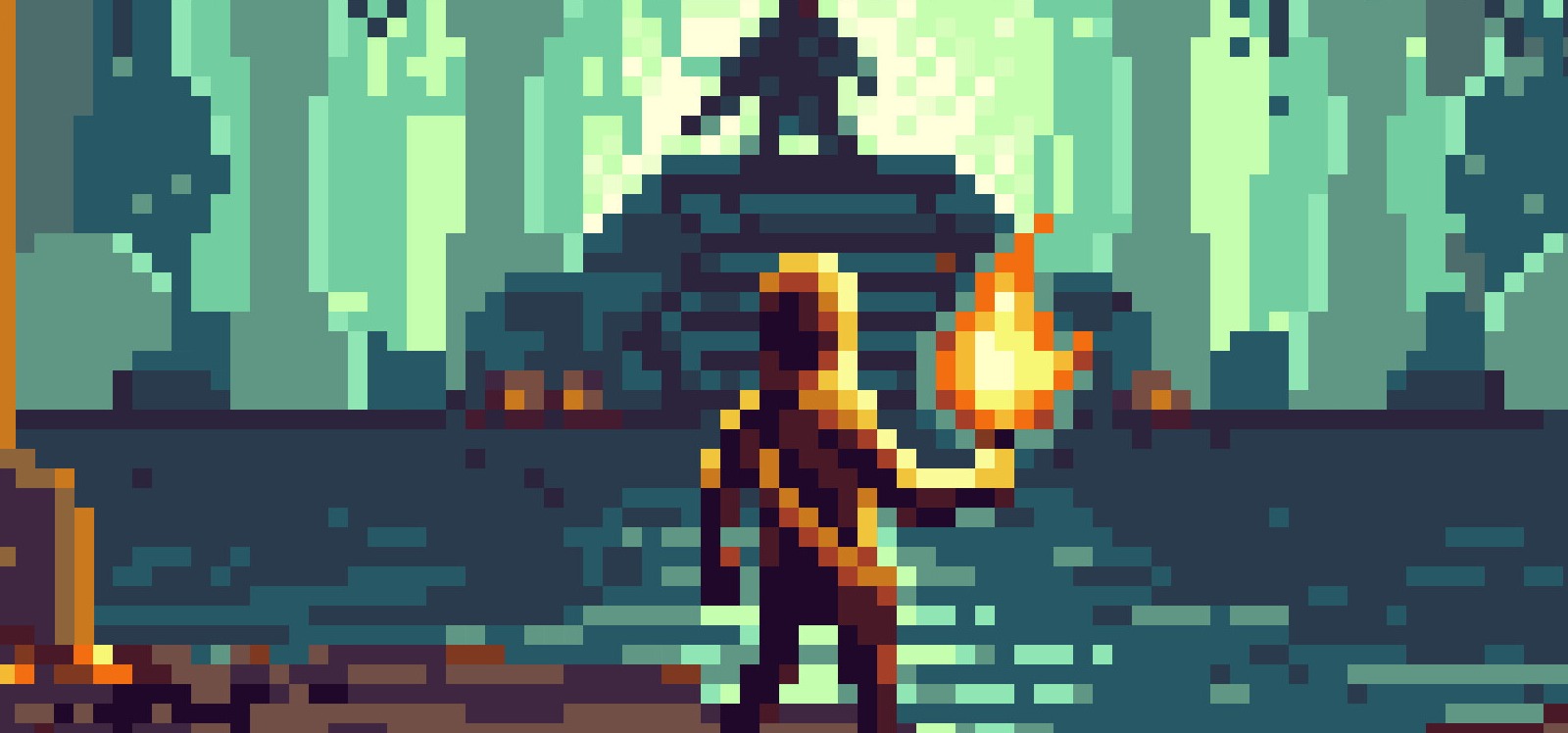
There is a moment in Delve Survivors where you step one square too far, the whole dungeon answers, and a screenful of skeletons collapses into loot at once. That is the hook: a classic grid-based roguelike where every move advances time, fused with the crowd-clearing adrenaline of a survivors-like. iDiOSLAB’s debut blends two very different rhythms into one, and the result is one of the most unexpectedly addictive releases of the November Steam lineup.
Game Overview
Delve Survivors launched on Steam on November 12, 2026 as a full 1.0 release, developed by iDiOSLAB and published by NGJ. It is a single-player, pixel-art dungeon crawler priced at $12.99 USD, with full controller support and a stack of accessibility toggles — adjustable difficulty, keyboard-only and mouse-only play, adjustable text size, and a “playable at your own pace” design that lets you stop and think.
The pitch is simple: descend procedurally generated dungeons, survive horde-scale encounters, collect ARPG-style loot, and build something ridiculous out of the skill tree before the dungeon kills you. Three heroes — Warrior, Archer, and Mage — start you off with different gear and traits, and the official line is that the world moves only when you do. That single rule changes how a survivors-like plays, and it is the best decision in the game.
World and Story
Story is deliberately thin here. You are a delver pushing through named locations — the Frozen Cave, Spider Cave, Cursed Graveyard, Demon’s Gate, Tower Ruins, Necropolis, and The Labyrinth — with a village hub where merchants and unlocks sit between runs. Do not expect cutscenes or a scripted narrative; the fiction is carried by the dungeon names, the bestiary, and the escalating dread of each floor counter.
What it lacks in plot it makes up for in structure. Each dungeon runs to a set depth, with boss encounters waiting at the end of the climb, and the world map screen gives the run a clear sense of progression through the region rather than an endless random shuffle. Players who come to this genre for atmosphere rather than lore will find exactly enough scaffolding to justify the next descent.
Gameplay and Combat
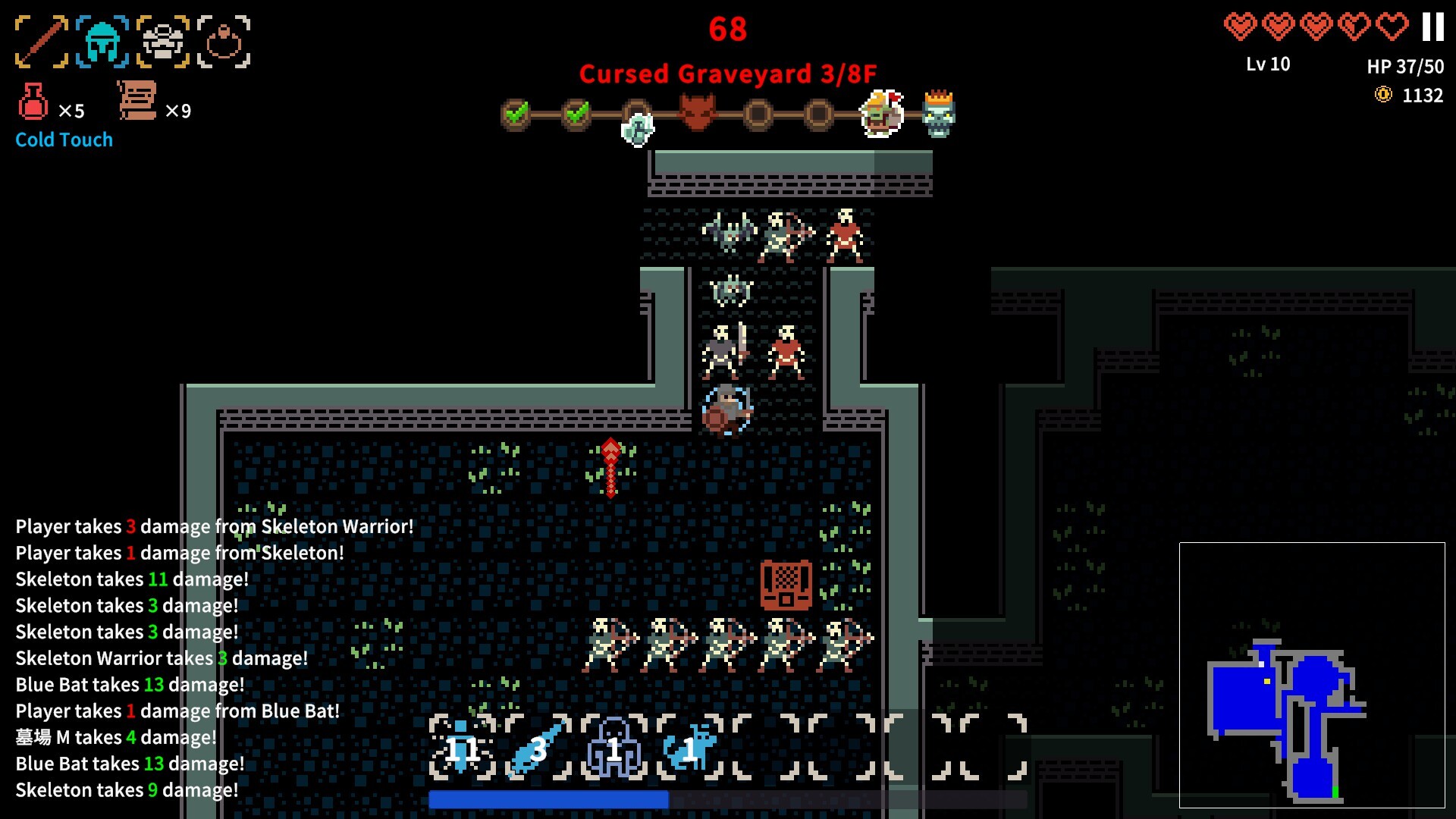
Combat is turn-based, but it never feels turn-based in the slow, chess-clock sense. Every step you take moves every enemy on the board, so the horde advances at the pace you set: hold back and plan each square, or push aggressively and let the swarm collapse around you. Enemies swarm in survivors-like numbers, your skills fire automatically on their cooldowns as turns pass, and positioning does the rest — dodging in a grid is a genuine skill when the telegraphs and attack ranges are this readable.
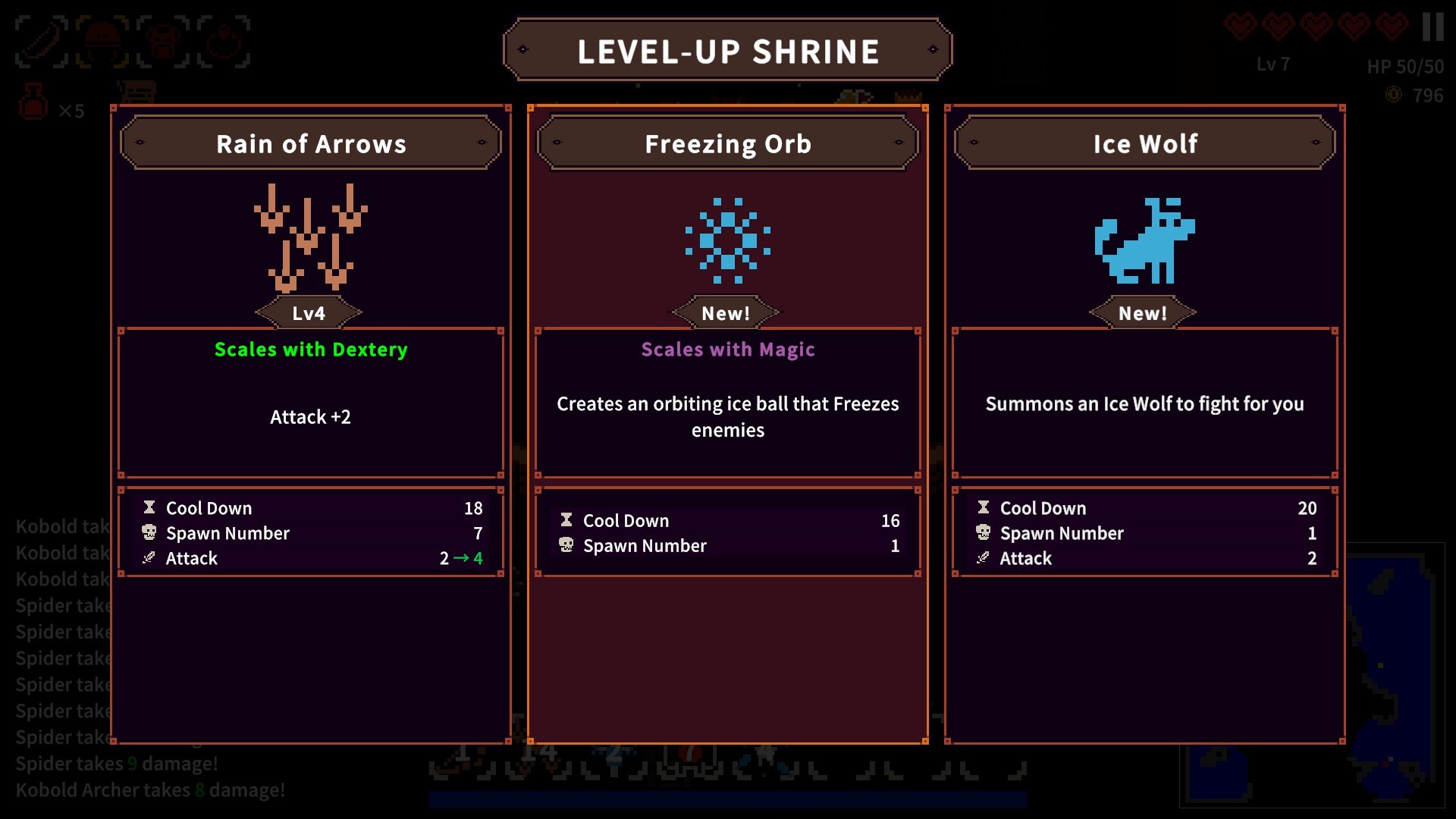
On level-up you pick one of three abilities — Rain of Arrows, Freezing Orb, Ice Wolf and dozens more — and from there the build writes itself. AoEs, status effects, and summons stack into combinations that can wipe a corridor in seconds, and the auto-casting design means your attention stays on movement and threat instead of a hotbar. Early Steam reviewers describe it as Crypt of the NecroDancer crossed with Vampire Survivors, and that comparison lands: the movement puzzle of a grid crawler with the screen-clearing payoff of a horde game.
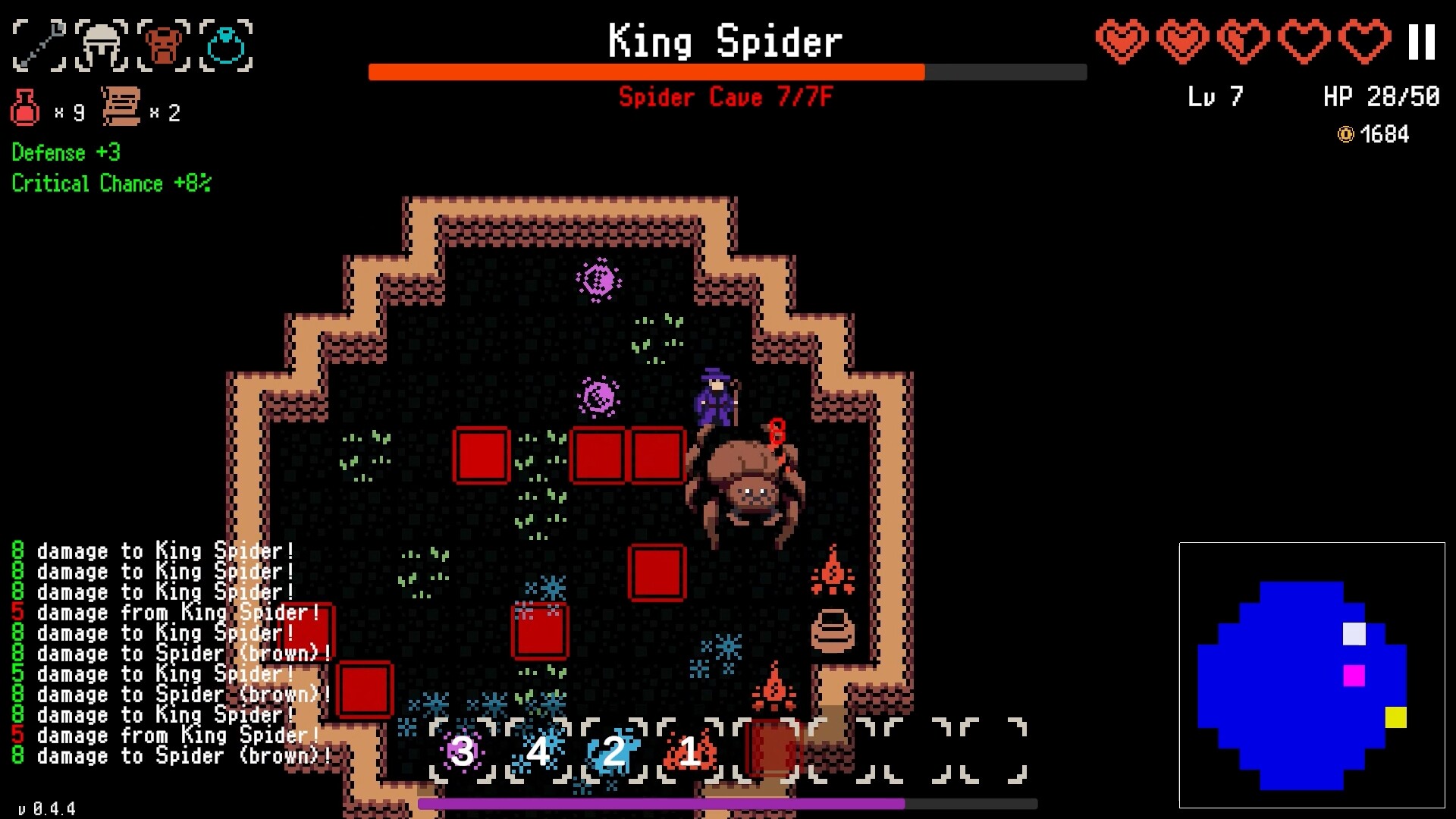
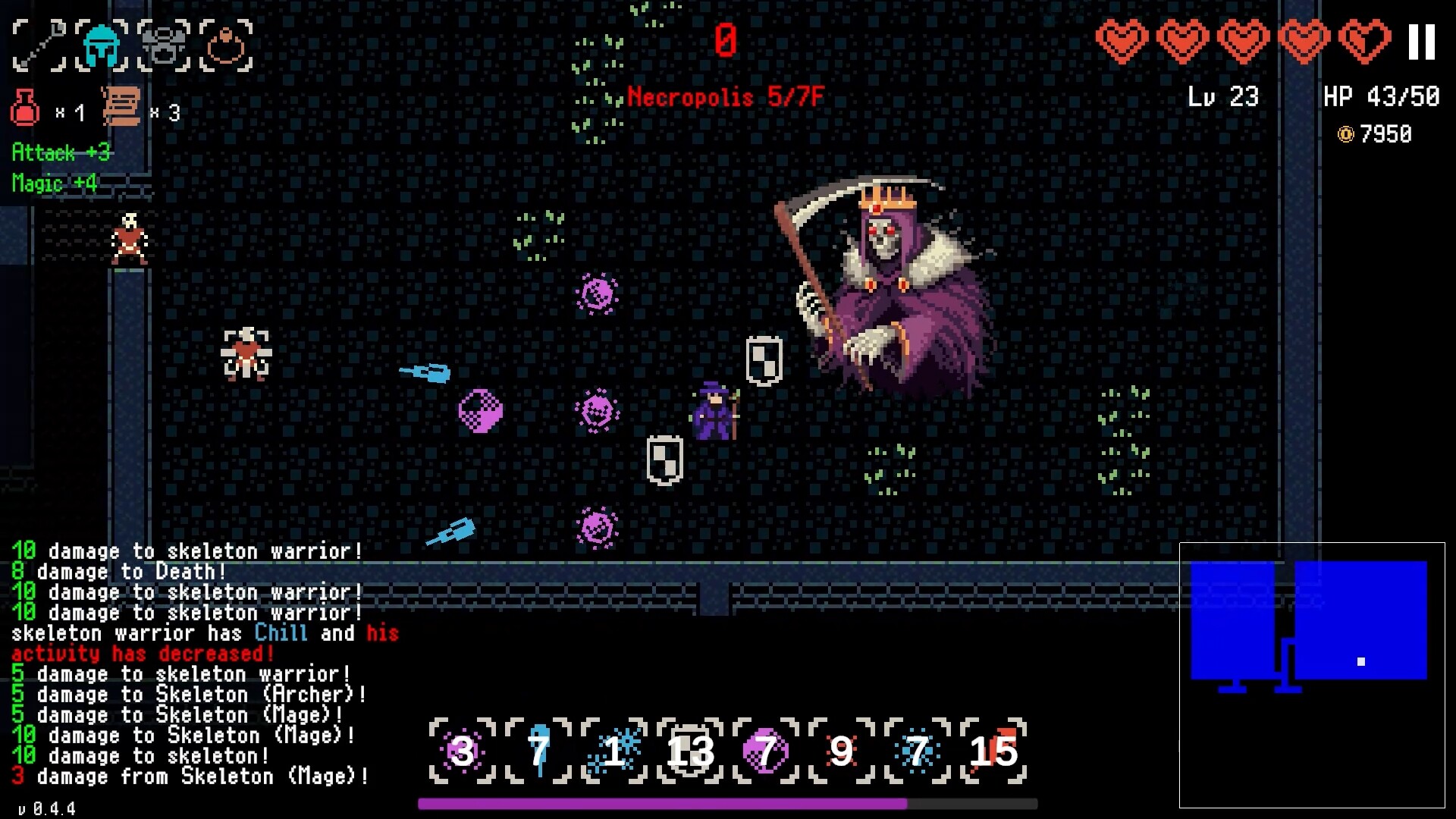
Bosses are where the tempo flips. Fights against the King Spider or the scythe-wielding Death force you to weigh positioning, cooldowns, and resource use one deliberate step at a time, with danger zones painted across the arena. It is the clearest expression of the game’s design: a survivors-style bullet pattern you solve at roguelike speed.
Progression and Replayability
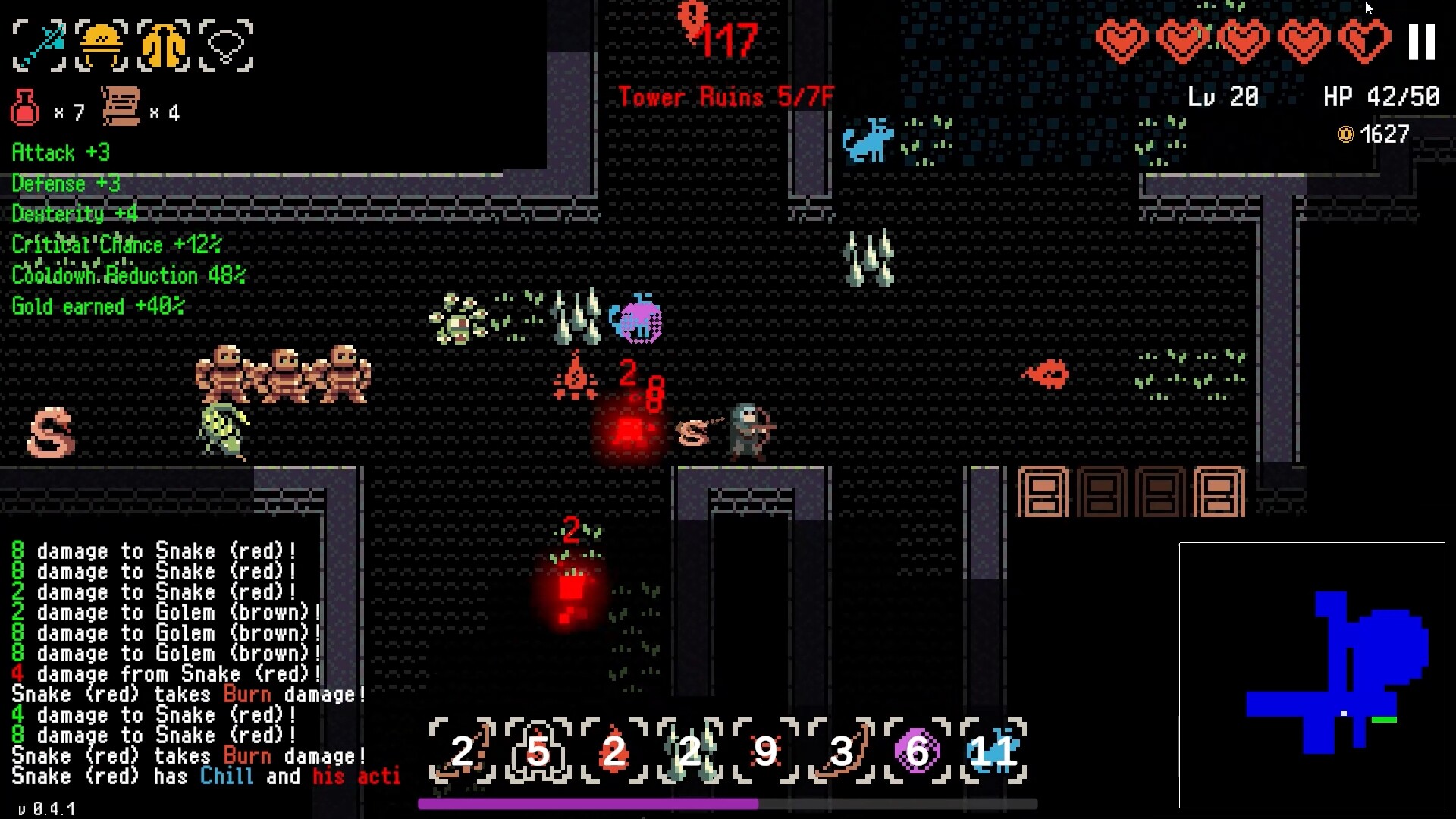
Under the chaos sits a loot game. Weapons, armor, and accessories drop in rarities up to legendary, the shop lets you improve and enchant pieces, and weapon reach and attack ranges mean a dagger build and a spear build play noticeably differently. Skills from level-ups pair with that gear to create the “one more run” pull the genre lives or dies by — and Delve Survivors has it in abundance, with reviewers noting that half an hour vanishes before you notice.
Death is also negotiable, which is smart design rather than a cop-out. Three modes let you pick your roguelike severity: Casual keeps your progress, equipment, and gold; Casual Rogue resets dungeon progress but keeps your gear and raises drop rates; Hardcore takes everything and gives the highest drops in return. Choosing your penalty up front means the run always has skin in the game without punishing players who just want to see the next floor.
Replay value comes from that loot depth plus the dungeon rotation, and the developers have been quick out of the gate: players reported a soft-locking floor tile bug on launch and a patch within days, alongside frequent skill additions. A shared stash across save slots, a requested item-lock feature, and achievements are on players’ wish lists, which suggests the run-to-run loop has room to grow rather than already being fully mined.
Visuals, Audio and Atmosphere
The pixel art does a lot of quiet work. Dungeons are legible even at swarm density — you can always read where you are, where the exits are, and which squares are about to hurt — and each region has its own palette and tile identity, from the blue crypts of the Necropolis to the red danger markers of a boss den. Character sprites are small but expressive, and the damage numbers and shield pips give combat a crisp, arcade-like feedback loop.
Audio is the surprise standout. Reviewers repeatedly call out the soundtrack as the thing that makes the turn-based combat feel like dancing around enemies — tempo without real-time pressure, which is a hard trick to pull off. Between the music, the chunky hit feedback, and the old-school dungeon atmosphere, the game lands the nostalgia of Rogue and NetHack while playing like something built for a modern Steam audience.
Performance and Technical
Delve Survivors runs on modest hardware by design: Windows 10 or 11 64-bit, an i5-1135G7 or Ryzen 5 5500U class processor, 4 GB of RAM, integrated graphics, and 1 GB of storage. That is an integrated-graphics-friendly spec sheet, and the pixel-art presentation is built to scale cleanly on everything from a desktop to a handheld.
At launch there are rough edges, and the community has been specific about them: enemy attacks and your own effects can look too similar in the heat of a fight (totem arrows in particular), controller stick sensitivity has no setting, the shop’s one-by-one unlock flow is tedious, and some equipment affixes do not make clear which skill they modify. The encouraging part is responsiveness — one soft-locking floor was patched within hours of being reported, and players confirm the fix landed fast. Early-days software, handled like it is being watched.
Pros and Cons
Pros: a genuinely fresh turn-based × survivors fusion; readable, tactical combat with real build variety; three death-penalty modes that respect different players; strong pixel art and a soundtrack that elevates the whole package; fast, visible developer support after launch.
Cons: dungeons can start to blur together beyond their visual themes after a few hours; loot and build depth do not always reach the power-curve highs of the best survivors-likes; UI and accessibility gaps around attack telegraphs, controller sensitivity, and shop management; balance can tip toward difficulty faster than your build comes online.
The Verdict
Delve Survivors is a small-budget idea executed with unusual confidence. It understands that a survivors-like is really about momentum and a roguelike is really about decisions, then puts both in the same square grid and lets you decide when to slow down. It will not convert players who need narrative weight or a hundred-hour meta, and the mid-game repetition is a fair criticism — but at $12.99 USD, with a loop this clean and a soundtrack this good, it is an easy recommendation for anyone who has ever wanted Vampire Survivors with a thinking cap.
Final score: 7.5/10 — an addictive, sharply designed mashup of roguelike tactics and survivor-scale carnage, held back only by shallow mid-game variety and a few launch-week rough edges.

Jordan Hayes covers PC gaming news, hardware, and the ever-changing Steam ecosystem for SteamGamer.net. He believes some of gaming’s biggest stories are hiding in patch notes, performance charts, and suspiciously quiet price changes. When he isn’t investigating what developers or GPU manufacturers are doing, he is probably starting another roguelike run he insists will be his last.






Comment here