

There’s a particular breed of shoot ’em up that refuses to die — not because it was ever a massive commercial hit, but because the people who loved it never stopped caring. Apidya, Kaiko’s 1992 Amiga cult classic about a man who transforms into a heavily armed bee to save his poisoned wife, is exactly that kind of game. For over three decades it lived in the collective memory of European retro gamers, a fever dream of insect-themed carnage and Chris Hülsbeck’s thunderous soundtrack that never quite got the second chance it deserved. Until now.
Apidya’ Special arrives as a ground-up rebuild of that original vision — not an emulation, not a remaster, but a faithful reconstruction built on a previously abandoned 1990s console port. Developed by the original team alongside a devoted super-fan-turned-developer and published by ININ Games, it’s the rare case of a remake made by the people who actually made the game in the first place. The result is something that feels both ancient and startlingly alive, a horizontal shooter that earns its place alongside Gradius, R-Type, and Thunder Force by doing what those classics always did best: making every bullet feel like it matters.
At $17.99 USD on Steam (currently discounted 10% from its $19.99 list price), Apidya’ Special lands on PC, PlayStation 5, Xbox Series X|S, and Nintendo Switch with a proposition that’s hard to resist for anyone who’s ever lost an afternoon to a vertically or horizontally scrolling shooter. But does this insect odyssey hold up when the nostalgia fades and the bullets start flying? After spending significant time with the game across its five worlds, here’s what we found.
Game Overview
Apidya’ Special is a side-scrolling shoot ’em up — a euroshmup, if you want to be precise about it — that slots firmly into the Gradius school of shooter design. You control Ikuro, a man transmuted into a bee by dark magic, as he fights through five themed worlds packed with insectoid enemies, organic hazards, and some of the most grotesque bosses this side of a David Cronenberg film. The game features 20 major bosses, 10 sub-bosses, hidden special stages, and a “Night Mode” that remixes enemy sprites and atmospheric tones for a genuinely different visual experience on repeat playthroughs.
The core loop is familiar territory for shmup veterans: destroy enemies, collect power-ups that advance along a weapon bar, and try not to die while the screen fills with projectiles and environmental hazards. What sets Apidya apart is its insect-themed art direction, its surprisingly rich world design, and a power-up system that rewards patience and strategic thinking over reflexes alone. There’s also a two-player co-op mode where a second player controls one of Ikuro’s helper drones, and a robust suite of accessibility options that make the game approachable without sanding off its edges.
World, Story, and Central Premise
The narrative setup is gloriously absurd in that way only early-’90s games could get away with. The sorcerer Hexaä poisons Ikuro’s wife Yuri with a toxin that conventional medicine can’t touch. Ikuro’s response? He uses forbidden shamanic arts to transform himself into a bee — a bio-energetically enhanced wasp, technically — and sets out to destroy the source of the poison across five increasingly hostile biomes. It’s the kind of plot that exists purely to justify why you’re shooting at giant snails and mechanical drones in a sewer, and it’s wonderful for it.
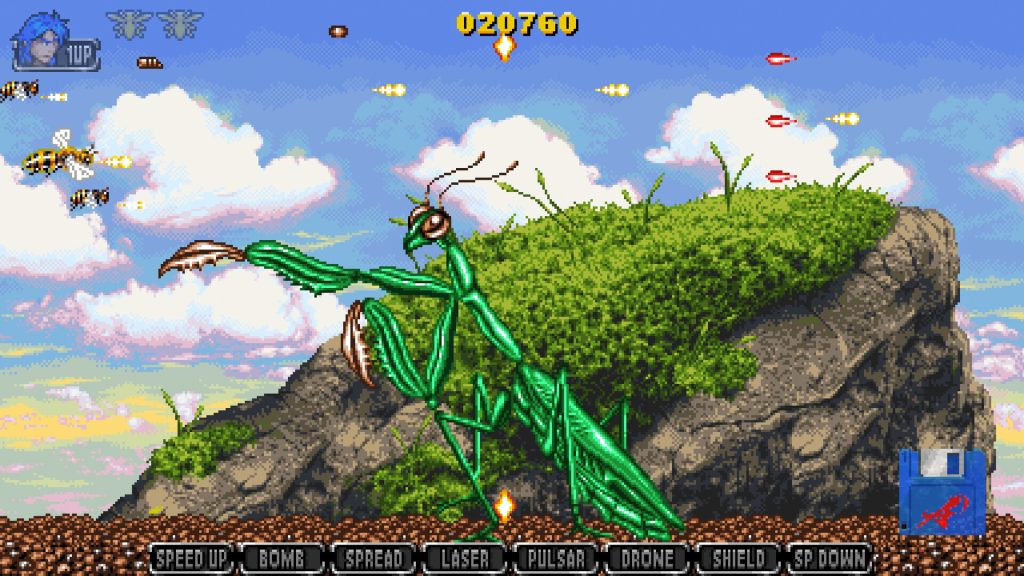
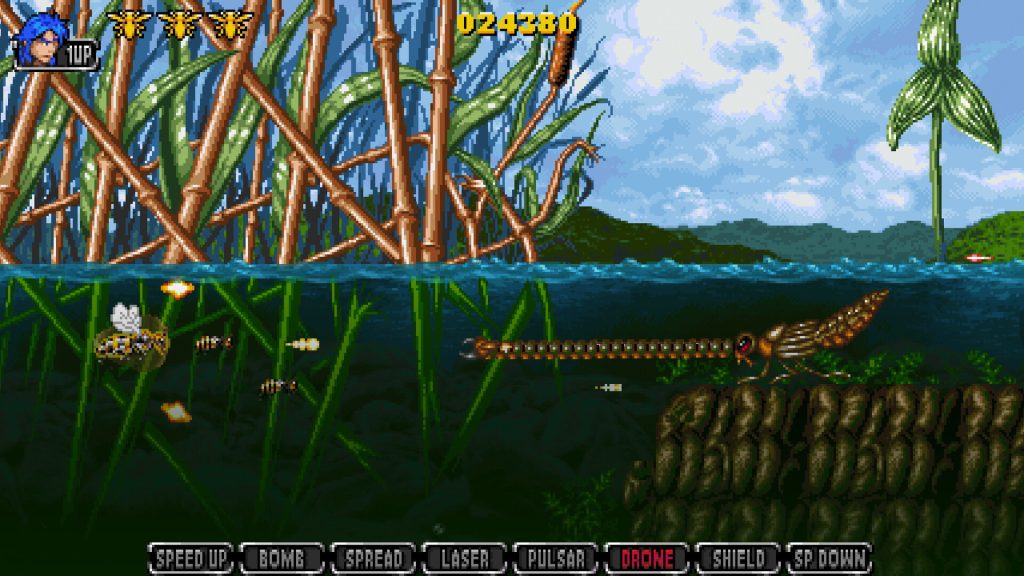
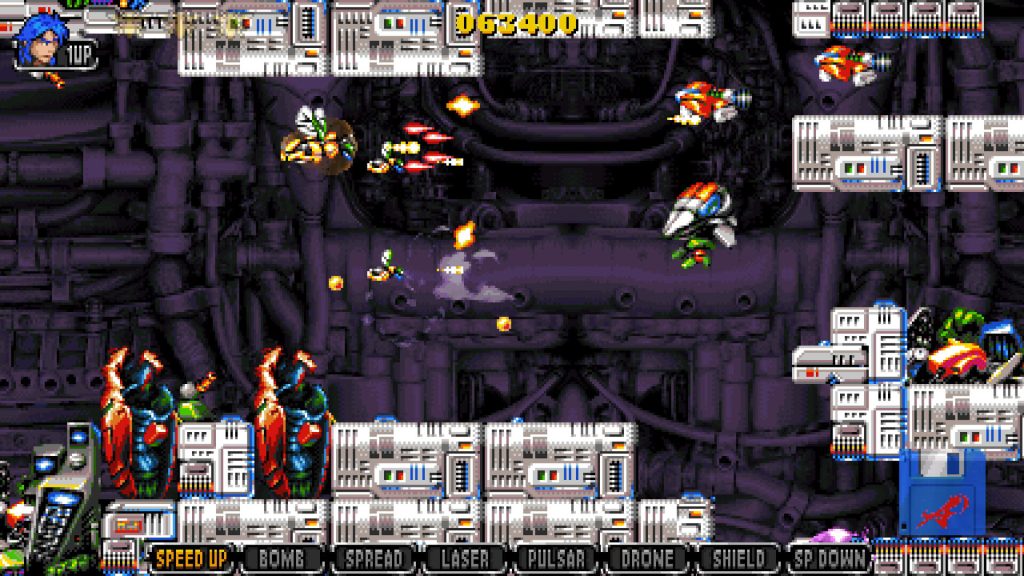
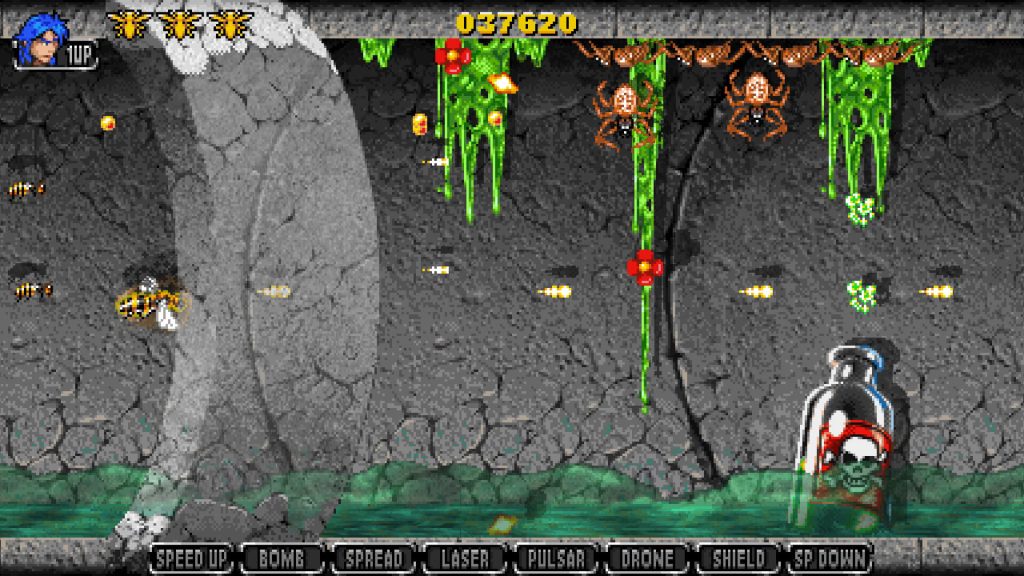
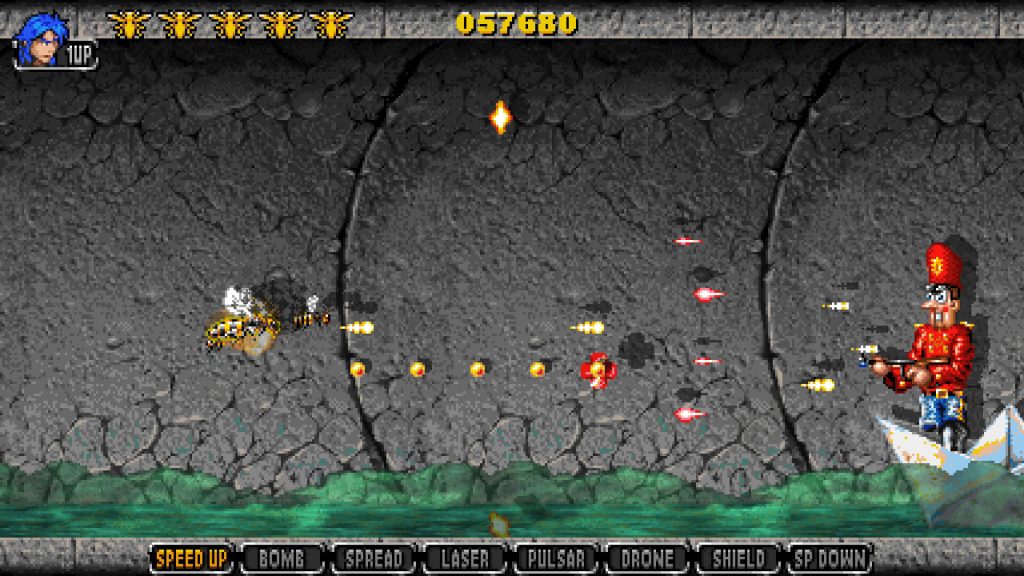
The five worlds each have a distinct visual identity and gameplay flavor. The Meadow opens things with rolling green landscapes and swaying vegetation that makes the environment feel genuinely alive. The Pond takes things underwater, where aquatic enemies replace their airborne cousins and the physics feel subtly different. The Sewers introduce industrial decay and toxic waste, with the Cyber world ramping up the mechanical menace before everything culminates in the Lair — a final gauntlet that pulls together every element the game has taught you.
Each world contains up to five levels, and the transitions between them are handled with a sense of escalation that the original Amiga version couldn’t quite achieve. The cutscenes, rendered in that distinctive anime-influenced style that defined early-’90s European game art, tell the story through dramatic still images with a surprisingly effective sense of pacing. Nobody’s playing Apidya for its narrative sophistication, but the presentation has a charm that modern games rarely attempt.
Gameplay and Combat
If you’ve played Gradius, you already understand the skeleton of Apidya’ Special’s combat. Defeated enemies occasionally drop flowers that advance a selector along a weapon bar at the bottom of the screen. Activate the highlighted slot and you unlock whatever enhancement it represents: speed boosts, spread shots, laser beams, guided missiles, helper drones, or a bio-energetic shield. The genius of this system is that it forces you to make real-time decisions about power allocation. Do you spend your flowers on a quick speed upgrade now, or save them for the devastating Plasma Pulse three slots further down the bar?
The wrinkle that makes Apidya’ Special feel distinct is the Stinger Beam — a charged forward-firing projectile that channels the spirit of R-Type’s iconic Force pod. Holding the fire button charges a devastating shot that can clear entire formations or chunk a boss’s health bar, but doing so temporarily restricts your standard offensive output. It’s a risk-reward dynamic that adds a layer of tactical depth to every encounter. Learning when to charge and when to fire freely is the difference between scraping through a level and dominating it.
Death is punishing but not quite as catastrophic as some of the genre’s most unforgiving entries. Losing a life weakens your weapons, leaving you less capable but not completely powerless. This creates the classic shmup tension: the better you perform, the easier the game becomes, but a single mistake can cascade into a string of demoralizing deaths as you limp through a section with reduced firepower. The accessibility options — adjustable lives, weapon retention after death, score thresholds for extra lives, and a full God mode — ensure that this tension can be tuned to match your tolerance level without compromising the core challenge for purists.
Progression and Replayability
A clean run through all five worlds takes roughly 45 to 60 minutes, which is par for the course in the shoot ’em up genre. The real measure of Apidya’ Special’s longevity isn’t the time it takes to see the credits — it’s the time it takes to actually master the game. Learning the boss patterns, optimizing your power-up routes, and developing the muscle memory to navigate the later worlds without dying demands hours of practice. The path to your first 1CC (one-credit clear) is a journey of incremental improvement that rewards patience and spatial awareness.
The randomized Night Mode adds genuine replay value by altering enemy sprites and atmospheric tones, creating a version of each level that feels familiar yet unpredictable. Hidden special stages offer additional challenges for completionists, and the co-op mode provides a completely different experience when a second player can split attention between Ikuro and a helper drone. For score attack enthusiasts, the adjustable scoring thresholds and leaderboard potential give the game a competitive edge that extends well beyond the initial playthrough.
There are five worlds, but the path through them isn’t always linear. Environmental hazards — walls, cliffs, spikes, and narrow passages — kill just as reliably as enemy bullets, and navigating them requires the kind of spatial awareness that separates casual play from genuine mastery. The later worlds, particularly the Cyber levels and the Lair, throw everything the game has at you in combinations that feel genuinely overwhelming until you’ve internalized the patterns.
Visuals, Audio, and Atmosphere
The visual overhaul is where Apidya’ Special makes its strongest case as more than a nostalgia exercise. The new 24-bit pixel art is genuinely gorgeous — handcrafted with a level of detail that the original Amiga hardware could never have rendered. The meadows sway with individual grass stalks, the underwater environments shimmer with realistic light diffusion, and the industrial settings pulse with mechanical menace. The ability to switch between the new widescreen presentation and the original 4:3 mode on the fly is a masterstroke, letting you appreciate exactly how far the art has come while still being able to experience the game as it originally looked.
The optional CRT filters are surprisingly well-implemented. The shadow mask simulation, scanlines, and phosphor bloom recreate that warm CRT glow without feeling gimmicky — it’s the kind of presentation option that lets you choose between modern clarity and retro authenticity without either feeling like a compromise. The 50 FPS option, which reproduces the timing of the original European Amiga release, is a nice touch for purists who want the game to feel exactly as it did in 1992.
Then there’s the soundtrack, and this is where Apidya’ Special might have its single greatest selling point. Chris Hülsbeck, the legendary composer behind Turrican and the original Apidya, contributes entirely new studio recordings of the iconic soundtrack alongside the classic Amiga versions. The new arrangements are stunning — orchestral重みのある synths layered over driving techno rhythms that capture the spirit of the originals while adding a richness that the Amiga’s Paula chip could only hint at. Being able to switch between the new and classic soundtracks on the fly is the kind of fan-service that actually enhances the experience rather than feeling like a checkbox feature.
Performance and Technical Problems
Apidya’ Special runs cleanly on modern hardware, with the smooth performance you’d expect from a 2D shooter. The game runs well on Steam Deck in handheld mode, making it a solid portable option for commuters and couch gamers alike. Frame rate stays locked during the most demanding sections, and input lag is negligible — the controls feel responsive and precise throughout.
That said, there are a handful of rough edges. Some players have reported that enemy projectiles can occasionally clip through boss hitboxes during specific attack patterns, creating unavoidable death situations. The aspect ratio switching between widescreen and 4:3 doesn’t always behave consistently — in some cases, switching to the classic mode doesn’t adjust the viewport correctly, which can lead to unexpected deaths if a wall crushes you during the transition.
Control mapping is another area that could use attention. The game uses F12 to switch visual modes, which conflicts with Steam’s default screenshot binding, and the pause function is mapped to the “Pause” key — a key that not every keyboard has. There’s no built-in control remapping option, which feels like a missed opportunity for a game that otherwise excels at accessibility. These aren’t game-breaking issues, but they’re the kind of quality-of-life oversights that a patch could easily address.
Pros and Cons
Pros
- Gorgeous 24-bit pixel art with seamless widescreen and classic mode switching
- Chris Hülsbeck’s remastered soundtrack is exceptional — possibly the best reason to play
- Tight, responsive controls with a satisfying Stinger Beam mechanic
- 20 bosses and 10 sub-bosses with distinct patterns and visual designs
- Robust accessibility options including God mode, adjustable difficulty, and weapon retention
- Two-player co-op mode with helper drone gameplay
- Night Mode randomization adds genuine replay value
- CRT filters that actually enhance the experience
Cons
- Unforgiving difficulty that can feel unfair in the later worlds
- Environment collision detection is overly strict in places
- Green enemies can blend into grassy backgrounds, causing frustrating unseen deaths
- No control remapping — Pause key and F12 conflicts are annoying
- Some hitbox inconsistencies with boss projectiles
- Aspect ratio switching between modes can be inconsistent
- Short overall campaign length if you’re not chasing mastery
SteamGamer Verdict
Apidya’ Special is the rare remake that understands what made its source material special and builds on it without losing the soul. It’s Gradius with bugs — and that’s a compliment, because Gradius with bugs is exactly the kind of game the genre needs more of. The pixel art is stunning, the Hülsbeck soundtrack alone justifies the price of admission, and the Stinger Beam mechanic adds enough tactical depth to keep the gameplay engaging well beyond the initial novelty.
Is it perfect? No. The collision detection can be harsh, the controls could use remapping, and some of the visual clarity issues in the grassy environments feel like oversights in an otherwise meticulously crafted package. But these are minor complaints in the context of what Apidya’ Special achieves: it takes a 34-year-old cult classic and makes it feel essential for a new generation of shoot ’em up fans while giving veterans the definitive version they’ve been waiting for.
For $17.99 USD, this is an easy recommendation for anyone who’s ever loved a horizontal shooter. The challenge is real, the presentation is gorgeous, and the soundtrack is genuinely memorable. Apidya’ Special doesn’t just crawl out of the Amiga’s back catalog — it flies.
SteamGamer Score: 8.5/10

Jordan Hayes covers PC gaming news, hardware, and the ever-changing Steam ecosystem for SteamGamer.net. He believes some of gaming’s biggest stories are hiding in patch notes, performance charts, and suspiciously quiet price changes. When he isn’t investigating what developers or GPU manufacturers are doing, he is probably starting another roguelike run he insists will be his last.




Comment here